Chatroulette Review: What Actually Changed
The site that invented random video chat doesn’t work the way you remember. It’s been rebuilt around profile pictures and a paid currency, which is a different product wearing a familiar name.
Chatroulette still exists, but it is no longer instant and no longer random. You browse photos and both sides have to agree before video starts, which makes it closer to a matching app than the roulette it’s named after.
If you’re here because you remember the original, that product is gone. If you specifically want to see who you’re connecting to before committing, this now does that better than most free platforms.
How Chatroulette Got Here
Built by a 17-year-old
Andrey Ternovskiy launched it from his bedroom in Moscow as a side project. Two video feeds, a text box, and a Next button. No accounts, no filters, no profiles. Adobe Flash, peer-to-peer video. Source: Wikipedia
Peak
Roughly 35,000 concurrent users at its height, national press coverage, celebrity appearances, and a genuine cultural moment. The entire product was still two feeds and a button.
Long decline
Flash gave way to WebRTC, optional accounts arrived, and moderation improved gradually. But purpose-built competitors took the audience, and the defining problem, being shown things you didn’t want to see, was never solved.
Rebuilt as something else
Profile-picture browsing with mutual opt-in, a virtual currency called Quids, server-relayed video instead of peer-to-peer, and apps on both stores. Same name, different product.
How It Works Now
The core change is consent before connection. Rather than being dropped into a stranger’s video feed, you upload a profile picture, browse photos of other users, and a session only starts once both people agree.
That solves something real. Blind pairing is how people ended up seeing things they hadn’t asked to see, and an opt-in step largely fixes it. It also removes the thing that made the site what it was. There is no longer a moment of not knowing who’s about to appear.
Video now passes through Chatroulette’s own servers rather than directly between users. That usually means more consistent quality across networks, and it means the other person can’t see your IP address, which peer-to-peer connections can expose.
One thing worth knowing before you start: the profile picture is labelled step one of two, so there’s at least one further stage before you can match. We stopped at the picture rather than completing signup, so we can’t tell you what the second step asks for. Budget more than the thirty seconds the original took.
There’s also an app on iOS and Android now, which the original never had. The browser version behaves identically, so it’s optional.
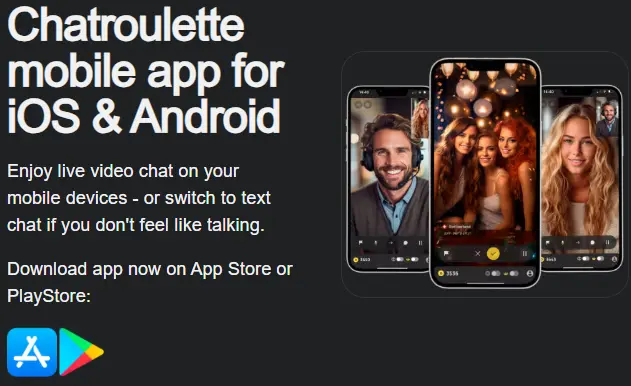
Chatroulette now offers apps on both stores, screenshot taken 2 Aug 2026.
What Quids Cost
Quids are earnable rather than purely purchased. New accounts start with a small balance, completed chats earn more, and you get a few whenever someone picks you.
The catch is that skipping costs one each time. On a platform historically defined by rapid skipping, that’s where the balance goes. Paid packages start around $1.99 and scale up, so nothing forces payment, but heavy use of the Next button is what pushes you toward it.
Worth being clear that this is a meaningful behavioural change rather than just a pricing one. The original rewarded skipping freely; this version taxes it.
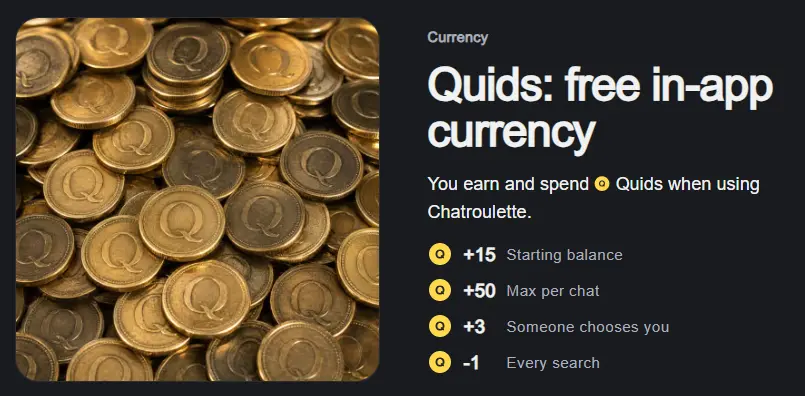
Chatroulette’s own explanation of Quids, screenshot taken 2 Aug 2026.
Chatroulette Compared
| Platform | Matching | See first | Gender filter | Account |
|---|---|---|---|---|
| Chatroulette | Photo, mutual opt-in | Yes | None | Signup required |
| Camsurf | Instant random | No | Partly free | Not required |
| ChatHub | Instant random | No | Premium | Not required |
| Shagle | Instant random | No | ~$28/mo | Not required |
| Emerald Chat | Interest-based | No | ~$6/mo | Encouraged |
Compiled from each platform’s published features, checked 2 Aug 2026. Full detail in our free platforms comparison.
Pros and Cons
- · Free to use, with no payment needed to start
- · Seeing a photo first genuinely reduces unwanted content
- · Apps on both iOS and Android
- · Server-relayed video means the other person can’t see your IP
- · No longer instant or random, which was the whole idea
- · Skipping costs Quids, and skipping is the core behaviour
- · A profile picture before matching means less anonymity than the original
- · No gender or country filtering at all
Who It’s For
If your complaint about random video chat is being shown things you didn’t ask to see, this addresses that more directly than anything else free. The opt-in step works.
If what you want is the 2009 experience, click and land on a stranger, no photos, no currency, this isn’t it and won’t be again. Camsurf or ChatHub are closer.
If anonymity is the priority, the profile picture requirement makes this a worse choice than it used to be. Our anonymity guide covers that in detail.
Common Questions
Yes, but it doesn’t work the way it used to. The rebuild replaced instant random pairing with a system where you upload a profile picture, browse other people’s photos, and both sides opt in before video starts.
Chatroulette’s in-platform currency. New accounts start with a small balance, you earn more for completed chats and for being picked, and each skip costs one. Packages start around $1.99. Skipping is what drains them fastest, which matters because skipping is what the platform was built around.
Less than it used to be. The original required nothing at all. The current version asks for a profile picture before you can match, which means handing over a still image of your face before you’ve spoken to anyone.
Yes, on both iOS and Android, which the original never had. The browser version works the same way, so the app is optional rather than necessary.
Third-party trackers estimate around three million monthly visits, well below its 2010 peak of roughly 35,000 concurrent users. Chatroulette doesn’t publish official figures, so treat that as an estimate.
Related
Nine platforms compared on cost, filters and moderation.
Four platforms, four different models, head to head.
What happened to Omegle, and which replacements are real.
Why the profile picture requirement matters if privacy is your priority.
How we reviewed this: we opened Chatroulette directly and worked through the start of signup, stopping at the profile picture step rather than completing registration, so observations about the onboarding flow are first-hand and observations about the matching experience itself are not. Screenshots are our own, taken 2 Aug 2026. Historical detail comes from contemporaneous reporting including Wikipedia, and traffic figures are third-party estimates rather than platform-reported. CooMeet is Vexycam’s affiliate partner and the only platform we earn from; Chatroulette pays us nothing. Full methodology and disclosure.